Quick answer Mercury Avator electric outboards are purpose-built for short-range, quiet, low-maintenance boating. They are a genuinely good fit for small boats on electric-only or HP-restricted lakes, cottage tenders, and dedicated quiet runabouts. They are not a replacement...
Quick answer
Mercury Avator electric outboards are purpose-built for short-range, quiet, low-maintenance boating. They are a genuinely good fit for small boats on electric-only or HP-restricted lakes, cottage tenders, and dedicated quiet runabouts. They are not a replacement for a gas outboard on a full-size fishing boat running a full day on Rice Lake. Understand the use case before you buy.
The honest take
Electric outboards have arrived. Not as a concept, as actual products you can buy, rig, and put on a boat. Mercury's Avator line is one of the more credible entries in that space because it comes from a manufacturer with real dealer infrastructure, real service support, and a track record we are familiar with.
I want to give you an honest take on Avator for Ontario boating, not the trade-show version where everything is "the future of boating," but the real version: where it fits, where it does not, what you need to make it work at a cottage, and what we would tell you if you walked into our shop asking about it.
What Mercury Avator actually is
Avator is Mercury's electric outboard family. Think of it the same way you would think of Mercury's Verado as a brand within the Mercury lineup. Avator is Mercury's electric offering, designed as a complete system: motor, battery, charger, controls, and displays built to work together.
It is not a trolling motor. It is designed to function as a primary outboard on the right size of boat.
Current Avator models (as of 2026):
| Model |
Output |
Battery system |
Best-fit boat |
| Avator 7.5e |
750W |
Integrated 1 kWh pack |
Very small (<14 ft) car-toppers, tenders |
| Avator 20e |
2,000W |
External 2,300Wh packs (up to 3) |
Small runabouts (14 to 16 ft) |
| Avator 35e |
3,500W |
External 2,300Wh packs (up to 4) |
Small to mid-size (14 to 18 ft) |
| Avator 75e |
7,500W |
5,400Wh Power Center (up to 4 packs) |
Mid-size (16 to 20 ft) on restricted lakes |
| Avator 110e |
11,000W |
5,400Wh Power Center (up to 4 packs) |
Larger (18 to 22 ft) on restricted lakes |
Mercury rates Avator by output power in watts and kilowatts, not by gas-engine HP equivalency. Focus on matching the power output to your hull weight and use case, not on translating to "X hp."
Where Avator makes sense for Ontario boaters
Electric-only or HP-restricted lakes
This is the strongest argument for Avator in Ontario. There are lakes in the Kawarthas, Algonquin, and across cottage country where motorboats are restricted, either to electric-only operation or to low HP limits. On those lakes, Avator is not competing with a gas outboard. It is competing with not having any meaningful propulsion at all.
The Avator 35e, 75e, and 110e fit squarely into restricted-use scenarios where an electric motor of meaningful power is genuinely needed.
One important note on regulations: HP restrictions and electric-only restrictions are not the same thing, and they vary by specific water body. Some "electric only" lakes technically permit electric motors up to 7.5 kW aggregate power under the federal Vessel Operation Restriction Regulations, which covers the larger Avator models. Confirm your specific lake rules before you buy anything.
Electric vs gas decision
Is the Avator the right call for how you actually boat?
Electric outboards have a real place in Ontario, but the range and recharge math is honest. Match the motor to the use case, not the headline.
Avator electric makes sense
- ✓Small calm lake, mostly under 3 hours per outing
- ✓Electric-only or strict HP-restricted water
- ✓Quiet morning fishing or noise-sensitive cottage neighbours
- ✓Second boat alongside a gas-powered main rig
Avator 7.5e or 20e fits the job
Stick with gas FourStroke
- ✓Bigger water, longer days, or open lake crossings
- ✓You want range and quick refuel, not a recharge wait
- ✓Towing tubes or pulling a skier
- ✓One boat doing every job
Mercury 9.9 to 25 FourStroke
When in doubt:The Avator is not a one-for-one swap for a gas kicker. It's a different tool. If you're not sure your typical outing fits inside the runtime envelope, the FourStroke is still the safer call.
Small boats making short runs from a cottage dock
A 14-foot aluminum boat or a small fibreglass tender making short trips, across the bay, to a nearby island, up a quiet river, is a good Avator candidate. The range is enough, the charging setup at most cottages (standard 110V outlet) is workable overnight, and you get genuine benefits: no fumes, minimal noise, very low maintenance.
The Avator 7.5e on a light car-topper can run about 5 miles at full throttle on a single 1 kWh battery, or up to 34 miles at quarter-throttle.
Noise-sensitive situations
Early morning fishing, evening cruises, areas where exhaust smell is genuinely objectionable. Avator near-silent operation is a real advantage.
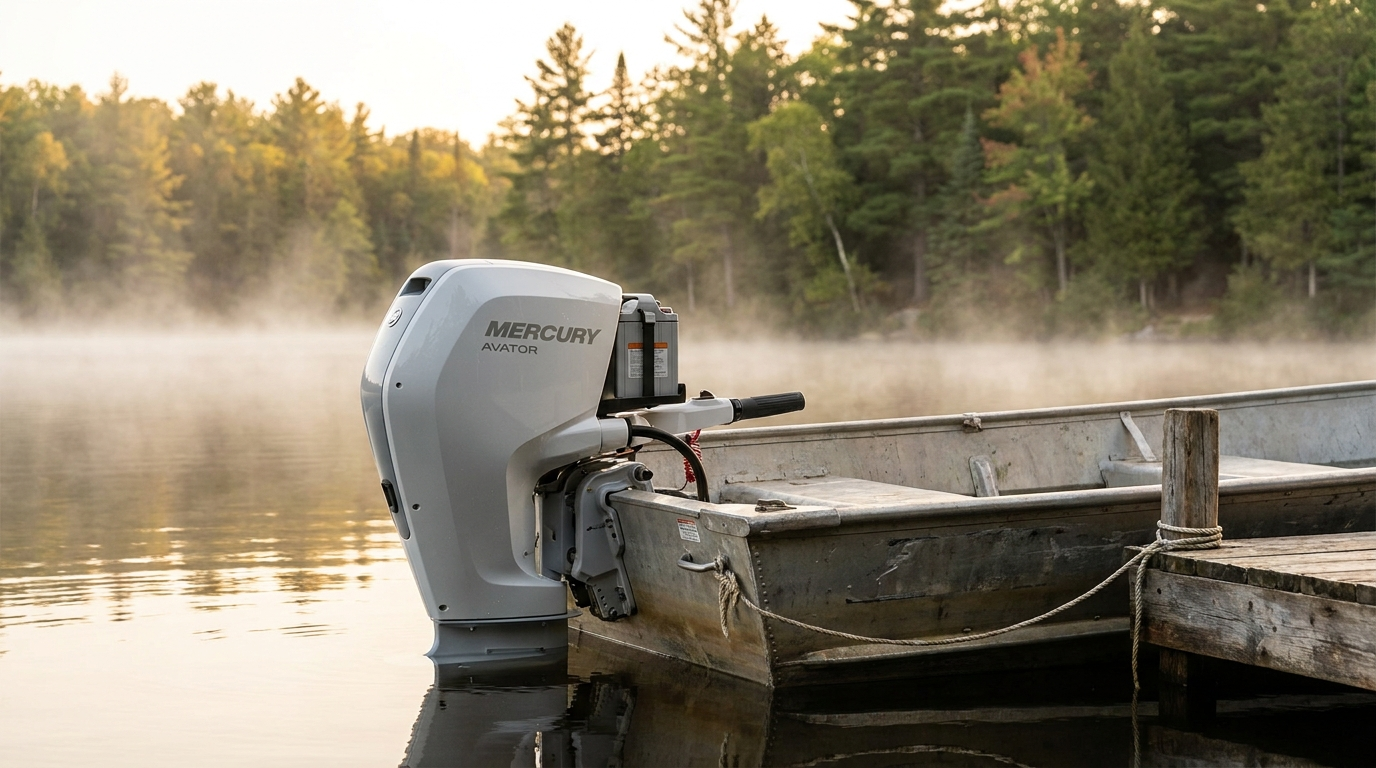
A second, dedicated quiet boat alongside a gas-powered main boat
This is how a lot of cottage families would realistically use Avator in Ontario. Your main boat is a gas-powered fishing rig that handles the full-day, long-range work. The Avator-powered small boat is what you take out in the morning for fishing close to the dock.
You can build a live CAD quote for your repower online at Mercury Repower Centre.
Where Avator does not make sense right now
Avator is not a replacement for a gas outboard on a full-size fishing boat doing full-day work in 2026.
If you are running a 17-foot aluminum boat around Rice Lake for 6 to 8 hours, trolling for walleye across multiple spots, running back into a headwind in the afternoon, a gas FourStroke is still the right answer. Battery capacity and charging logistics are not there yet for that use case.
Similarly, if your cottage does not have reliable shore power or you are camping-style remote, charging logistics become complicated. Avator needs a place to plug in overnight, and that needs to be a real plan before you buy.
To be fair to the technology: the Avator lineup launched the 75e and 110e in 2024, and Mercury is clearly committed to expanding the line. The medium-term trajectory is real. But buying what exists today for a job it is not quite ready for is still a mistake.
What charging looks like at an Ontario cottage
The Avator 7.5e integrated 1 kWh battery charges from a standard 110V outlet in roughly 3 to 4 hours. For the larger external 2,300Wh packs, plan on overnight charging from a 110V outlet per pack. If you have multiple packs, you either need multiple outlets running simultaneously or a 240V charger to speed things up.
At a typical Ontario cottage with standard electrical service, overnight charging works for most uses. What does not work is rolling in at 4pm after a long day, expecting to go back out that evening on a flat battery. Plan your charging like you would plan fuelling.
Avator vs a small gas FourStroke vs a trolling motor
Traditional 12V/24V trolling motor:
- Cheapest option
- Very low speeds, mainly for controlled fishing positioning
- Not a primary outboard
- No useful thrust for getting somewhere
Mercury FourStroke 2.5 to 9.9 HP:
- Proven, reliable, easy to service anywhere
- Works on any lake with any restriction up to 10 HP
- Has to be winterized and fuelled
- Makes noise and exhaust
Mercury Avator:
- Real outboard-style thrust and steering
- Near-silent operation, no fumes
- Significant upfront cost when battery packs are included
- Charging dependent on shore power access
- Right for specific use cases, not all use cases
For most Rice Lake fishing boats running a full day with multiple people, a gas FourStroke plus a trolling motor is still the most practical combination. If your situation involves an HP-restricted lake, a dedicated quiet boat, or a small tender application, Avator enters the conversation seriously.
Pricing and how to get a quote
Avator pricing changes as the line evolves, and battery pack costs are separate from motor costs. The relevant comparison is the all-in system cost: motor plus the battery packs you would actually need.
Contact us with your boat type, size, and how you plan to use it. We will put together a realistic quote and tell you which Avator model, if any, actually fits your situation. If a gas motor is the better answer, we will tell you that too.
Our honest take
We like Avator for what it is. Mercury built it as a real product backed by a real dealer network, and that matters in a space full of startups making promises they cannot service. We can support these motors because we are a Mercury Platinum dealer.
But we are also a shop that has been on Rice Lake since 1947, and we have watched a lot of technology trends come through the marine industry. The customers who fare best are the ones who match the technology to their actual use case, not the marketing version.
If a short-range quiet runabout is genuinely what your cottage situation calls for, Avator is worth serious consideration. If you are looking for a full-day fishing motor that handles Rice Lake top-to-bottom in a 17-foot aluminum boat, a gas FourStroke is still the right answer today.
Ready to price it out? Build a live CAD quote for your repower online at the Mercury Repower Centre.
Last reviewed: 2026-05-11.
