Last reviewed: 2026-05-23 > Quick answer: For Rice Lake walleye fishing, a Mercury 9.9 ProKicker is the standard kicker motor, and for good reason. It trolls cleanly at the 1 to 2 mph walleye demand, runs all day on very little fuel, and doubles as your get-home motor on a 32...
Last reviewed: 2026-05-23
Quick answer: For Rice Lake walleye fishing, a Mercury 9.9 ProKicker is the standard kicker motor, and for good reason. It trolls cleanly at the 1 to 2 mph walleye demand, runs all day on very little fuel, and doubles as your get-home motor on a 32 km lake. The current EFI ProKicker comes with a Command Thrust gearcase and a high-thrust prop. Build a quote at mercuryrepower.ca.
Let us skip the preamble. If you fish Rice Lake for walleye, you need a kicker motor. That is the whole answer.
Everything below explains why, and which version of the Mercury 9.9 to get, how it differs from the standard 9.9, and what we have learned rigging these on fishing boats on this specific lake. We have been setting up boats on Rice Lake's south shore for three generations, and the kicker is the single most common thing customers wish they had added at purchase instead of a year later.
If you are already sold and just want pricing, go to mercuryrepower.ca. If you want to understand why the ProKicker exists and why it matters on Rice Lake, read on.
What the Mercury 9.9 ProKicker Actually Is
Mercury makes more than one version of the 9.9 HP motor, and most people do not realize it. That causes confusion at buying time.
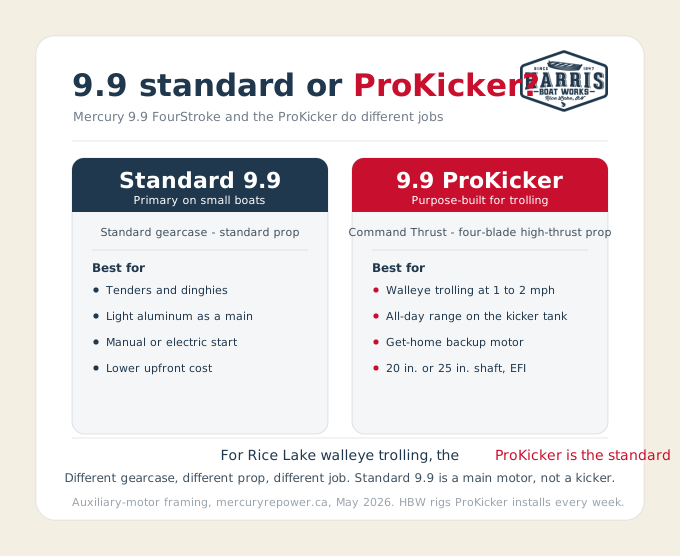
The standard 9.9 FourStroke is a primary motor. It powers tenders, dinghies, and light aluminum boats. It is geared and propped to move a small boat at its own best speed.
The 9.9 ProKicker is a different animal. It is a purpose-built kicker, engineered to troll alongside a larger main motor. Mercury introduced the current EFI ProKicker in June 2024, replacing the older carbureted version. Anything you buy new in 2026 is the EFI model.
Two things make the ProKicker a trolling motor instead of just a small outboard:
- A high-thrust, four-blade propeller. This prop is built for low-speed control, not top speed. It gives you precise, repeatable trolling speeds down in the range walleye actually want.
- Mercury's heavy-duty Command Thrust gearcase, standard. The larger lower unit puts more bite in the water, which means better thrust at slow speeds and better control in chop. On the EFI ProKicker this gearcase is not an upgrade. It comes on the motor.
The EFI ProKicker also comes with power tilt as standard, so you raise and lower the kicker with a button instead of reaching over the transom. The result is a motor designed to troll at 1 to 2 mph all day without the surging and hunting you get when you ask a standard outboard to run below its comfort zone.
The standard 9.9 is not that motor. It can push a small boat. It cannot troll a fishing boat the way Rice Lake walleye demand.
Why a Kicker Matters on Rice Lake Specifically
Rice Lake is a trolling lake. That is just the truth of it.
The walleye fishery, which is the reason most people come here, is built around slow trolling with worm harnesses along weed edges and over shallow flats. The productive speed is 1 to 2 mph. In some conditions, slower than that.
Your main motor cannot do this cleanly, whatever size it is. At true idle in gear, most 60 to 115 HP outboards push a typical aluminum fishing boat at 3 to 4.5 mph. That is not a Rice Lake walleye speed. It spins your harnesses too fast, it puts fish off, and it wastes your day.
Noise is the other problem. A big four-stroke at idle is still a big four-stroke at idle. In 8 feet of water over a weed flat, that matters. Shallow-water walleye are spooky.
The ProKicker solves both problems at once. The main motor tilts up out of the water. You run on the kicker: quiet, slow, dialled in. You cover your pattern and you catch fish.
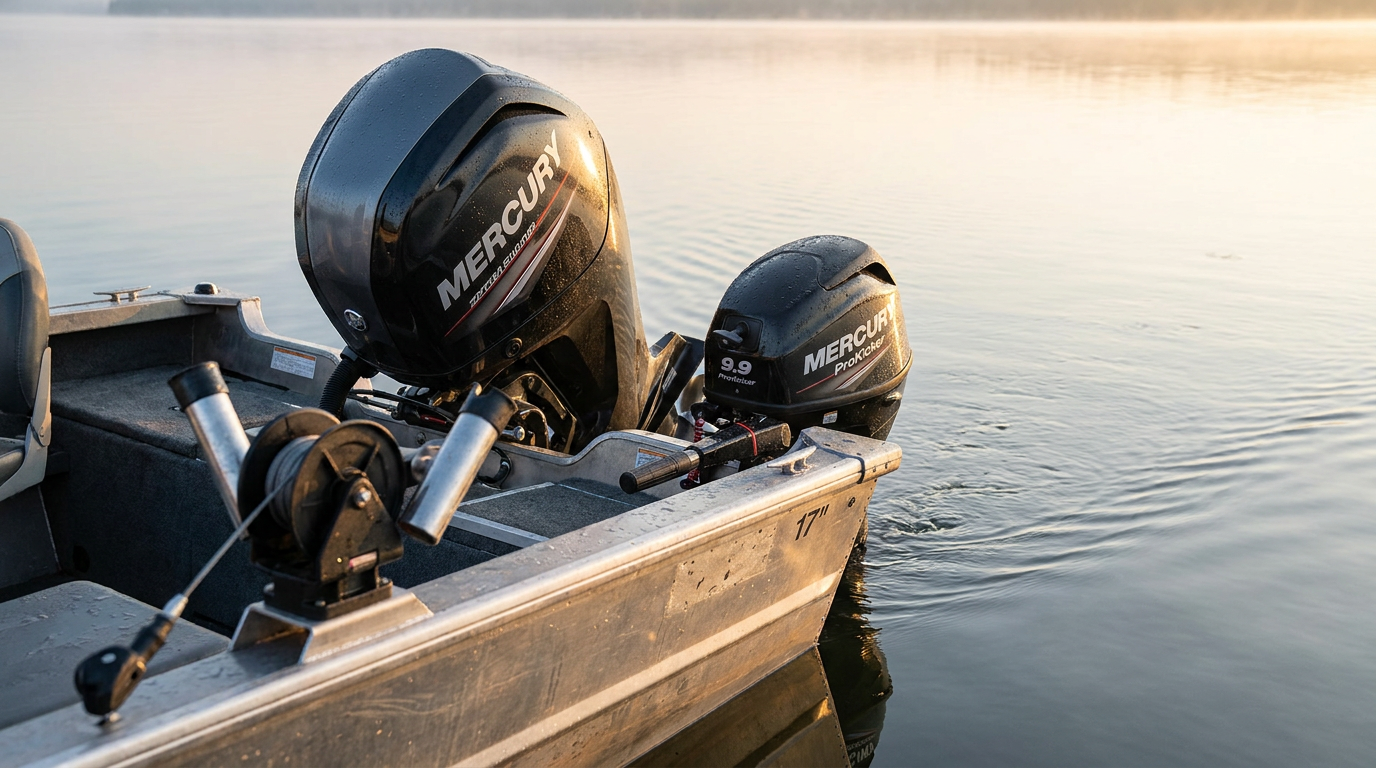
It also happens to be your backup motor when the main decides not to cooperate at the far end of the lake. On a 32 km lake with the afternoon west wind building, a second motor that can get you home is worth thinking about. For more on how that wind shapes a day on this water, see our Rice Lake fishing guide.
ProKicker vs Electric Trolling Motor: The Rice Lake Answer
This question comes up constantly, so here is the honest answer for this specific lake.
| Factor |
Mercury 9.9 ProKicker |
Bow-mount electric |
| Walleye trolling, open water |
Built for it |
Speed control gets marginal in chop |
| All-day range |
Full tank, full day |
Battery-limited, roughly 4 to 6 hours at moderate draw |
| Afternoon west wind |
Handles the chop |
Limited thrust above 1 to 2 ft chop |
| Shallow bass and panfish |
Gearcase still hangs down |
Works in a foot of water |
| Spot-lock / GPS anchor |
Not available |
The main reason to own one |
| Backup / get-home motor |
Gets you home |
Battery-dependent |
| Noise |
Quiet, not silent |
Silent |
For walleye trolling, the number-one use on this lake, the ProKicker wins clearly. Sustained speed control in open water, all-day range, and the ability to handle chop on a 32 km fetch are exactly what it was engineered for.
If you bass fish shallow bays and weed flats and want spot-lock precision, a bow-mount electric is the right tool for that job. The two are not really competitors. The electric finds and holds fish in close quarters. The ProKicker covers water on the long walleye runs. Most of the serious rigs we see on Rice Lake run both. We go deeper on that pairing in our kicker vs trolling motor guide.
Choosing Your ProKicker: Shaft, Start, and Controls
Because the EFI ProKicker comes standard with the Command Thrust gearcase and power tilt, you are not choosing a gearcase. The real decisions are shaft length, start type, and control type.
Shaft length. The ProKicker comes in 20 inch (long) and 25 inch (extra-long) shafts. A kicker mounts on an offset bracket beside your main motor, and the bracket plus your transom height decide what you need. Most 16 to 18 ft aluminum fishing boats take the 20 inch. Taller-transom console boats and many deeper-V hulls need the 25 inch. Do not guess this. Measure your transom, and factor in the bracket. A wrong shaft length puts the prop at the wrong depth and ruins both performance and cavitation behaviour.
Start type. Manual start does not require a cranking battery. Pull the rope and the motor charges its own ignition system. Electric start does need a battery, and on most fishing boats you already have one. Electric start matters most on bigger boats where the kicker is a stretch to reach.
Control type. Tiller control is simple and standard on most kicker installs. Remote control routes the kicker's throttle and shift to a binnacle or panel near the helm. Some anglers also add a tiller extension so the handle reaches the operator's seat without a stretch.
Best fit: most Rice Lake walleye boats
A 20 inch shaft, electric start, tiller-control EFI ProKicker covers the large majority of 16 to 18 ft aluminum fishing boats on this lake. It is simple, it reaches the water properly on a standard bracket, and electric start means no cord-pulling on a cold October morning. Heavier console boats step up to the 25 inch shaft and often to remote controls.
For 2026 pricing on any configuration, motor only or fully installed, use the live quote tool at mercuryrepower.ca. It shows actual HBW pricing in Canadian dollars, not MSRP.
What a ProKicker Installation Actually Involves
This is not a bolt-it-on-and-go job. It can be done that way. It should not be.
A proper ProKicker install on a Rice Lake fishing boat covers:
Bracket selection. The ProKicker needs an offset bracket to sit properly beside the main motor. Bracket height, setback, and swing clearance all have to match your specific hull. We have seen bad bracket choices that park the kicker right in the main motor's exhaust. We stock the right brackets and match them to the boat.
Fuel line integration. Most installs tie the ProKicker into the main fuel tank rather than running a separate portable. That means a proper tee fitting, primer bulb placement, and fuel routing that will not kink or pinch under the gunwale.
Tiller reach. The tiller has to reach the operator's seat without an awkward stretch. Some boats benefit from a tiller extension. This is easy to get right at install time and annoying to fix later.
Helm integration. Electric-start models need a key switch and wiring run to the helm. If you want kicker RPM shown on your chartplotter or a SmartCraft display, that is a conversation to have before the install, not after.
Sea trial. We run every install on the lake before you take delivery. Trolling-speed testing, fuel-flow confirmation, tiller-reach check. That is how we catch the things that look right on the transom and feel wrong on the water.
What We See at HBW
Three generations of rigging fishing boats on this lake teaches you a pattern, and the ProKicker is part of it. The customers who are happiest a year later are the ones who added the kicker at purchase. The ones who skipped it to save money almost all come back for it, and adding it later costs more, takes longer, and means undoing wiring we already ran.
The other thing we see: the kicker is not where people should economize. A correct bracket, the right shaft length, and a clean fuel tie-in are what make the difference between a kicker you forget about and a kicker that annoys you every trip. The motor is the easy part. The installation is where the experience is won or lost.
Common Mistakes
The "I'll add the kicker later" plan. Nobody adds it later cleanly. It costs more, takes longer, and disturbs wiring that is already in. Put it on at repower or rigging time.
The wrong bracket for the hull. A generic bracket that looked fine in the store creates problems on the water: wrong height, wrong setback, the motor kicking back on hard turns. Bracket choice is specific to your boat.
A separate portable fuel tank for serious use. A portable tank is fine for occasional fishing. For all-day walleye runs, tying into the main tank is cleaner and kills the mid-day tank-swap interruption. Do it at install time.
Manual start on a big boat. On a 19 ft console with a full cockpit, reaching the transom to pull-start a cold kicker in October is a real chore. Electric start is worth the cost on any boat where the kicker is hard to reach.
A mismatched prop. The ProKicker ships with a high-thrust, four-blade prop matched to the motor. Do not swap on a standard 9.9 prop, and do not change pitch without talking to someone who knows the motor. A "cheap" prop change can quietly cost you trolling-speed accuracy, which is the whole point of the motor.
The ProKicker on the Trent-Severn
Rice Lake's east end connects to the Trent-Severn Waterway, 386 km of locks, channels, and lakes running through to Georgian Bay. If your fishing reaches into the system, the ProKicker earns its keep twice over.
Lock-to-lock travel moves at displacement speed, so your main motor is fine for the run. But the ProKicker gives you precise low-speed control on a lock approach, and it is real peace of mind as a backup motor on a multi-day trip away from home water. Our Trent-Severn boating guide covers the rest of what a system trip involves.
Servicing Your ProKicker
The Mercury 9.9 EFI ProKicker is easy to live with. The EFI powerhead has no oil filter to change, and the camshaft is maintenance-free with no valve-lash adjustments for the life of the engine. That leaves a short, predictable service list:
- Annual service: engine oil change, gear lube, fuel filter, spark plug inspection, and a general going-over. Once a year or roughly every 100 hours, whichever comes first.
- Water pump and impeller: Mercury's schedule puts water pump service in the 300-hour range. On Rice Lake's weedy, silty water we often recommend it sooner, every 2 to 3 seasons. The impeller is the single most important item on any water-cooled outboard. Do not stretch it.
- EFI throttle body: inspect and clean every few seasons if you run ethanol-blended fuel regularly.
HBW services Mercury and MerCruiser. Book kicker service at hbw.wiki/service. The best time is fall lay-up or early spring before the walleye opener, so your kicker is ready and you are not waiting in the May queue. Our spring commissioning checklist walks through the rest of the pre-season list.
Frequently Asked Questions
What is the difference between the 9.9 ProKicker and the standard 9.9 FourStroke?
The ProKicker is purpose-built for trolling. It has a high-thrust four-blade propeller, Mercury's Command Thrust gearcase as standard, and power tilt as standard. The standard 9.9 FourStroke is a primary motor for small boats, geared and propped for its own best speed. The ProKicker is engineered to troll slowly all day alongside a larger main motor.
Do I need a kicker for Rice Lake walleye?
For proper walleye trolling, yes. Main motors at idle run too fast and too loud for an effective presentation here. The Mercury 9.9 ProKicker is the standard kicker on Rice Lake fishing boats because it runs the right speed, quietly, for hours.
Does the EFI ProKicker need a battery to start?
The manual-start version does not. Pulling the rope charges the ignition system on its own. The electric-start version does need a cranking battery, which most fishing boats already have.
What shaft length do I need?
The ProKicker comes in 20 inch and 25 inch shafts. Most 16 to 18 ft aluminum fishing boats take the 20 inch. Taller-transom console and deeper-V boats need the 25 inch. Measure your transom and account for the offset bracket. Do not guess.
Can I run the ProKicker off my main fuel tank?
Yes, and we recommend it for serious fishing. We plumb the ProKicker into the main tank at installation so you are not swapping a portable tank mid-day.
How much fuel does a ProKicker use trolling?
Very little. At typical walleye trolling speeds it sips fuel, so a main tank running the kicker alone lasts for days of fishing. Exact consumption depends on boat, load, and conditions.
What is the top speed of a 9.9 ProKicker?
Low, by design. The high-thrust prop and gearing trade top speed for slow-speed control. The ProKicker is not built to cover distance. To move between spots, tilt the kicker up and run on your main motor.
Does HBW service ProKickers it did not install?
Yes. We service any Mercury or MerCruiser regardless of where it was bought. Book at hbw.wiki/service.
Does the ProKicker work on the Trent-Severn?
Yes. It is used for trolling on the connecting lakes and as a backup motor on cruising routes, and it gives precise low-speed control on lock approaches.
Ready to Add a ProKicker?
Live pricing, motor only or fully installed, is at mercuryrepower.ca. The quote tool shows actual HBW pricing in Canadian dollars, not MSRP.
Call 905-342-2153 to talk through bracket choice, shaft length, and installation before you commit. We have done enough of these on Rice Lake fishing boats that we will have your specific hull sorted in about five minutes.
Phone: 905-342-2153
Address: 5369 Harris Boat Works Rd, Gores Landing, ON
Configurator: mercuryrepower.ca
Service: hbw.wiki/service
Sources
- Mercury Marine, "Mercury Marine Introduces 8 and 9.9hp EFI FourStroke and 9.9hp EFI ProKicker Outboards" (June 6, 2024): mercurymarine.com/us/en/about-us/news/all-new-efi-fourstroke-and-prokicker-outboard
- Mercury Marine, ProKicker outboard range: mercurymarine.com/us/en/engines/outboard/prokicker
- Mercury Marine, owner's resources and maintenance schedules: mercurymarine.com/us/en/service-and-support/owners-resources
Motor specifications and configurations are current as of May 2026. Confirm the exact model, shaft length, and pricing for your boat with HBW before purchase. Your owner's manual is the final word on service intervals.
Related guides:
