Last reviewed: 2026-05-23 > Quick answer: A repower means a new Mercury on your existing hull. For most Kawartha boats with a sound hull and transom, it is the smart move: you keep the boat you know and spend a fraction of the cost of new. A clean install runs one to two days...
Last reviewed: 2026-05-23
Quick answer: A repower means a new Mercury on your existing hull. For most Kawartha boats with a sound hull and transom, it is the smart move: you keep the boat you know and spend a fraction of the cost of new. A clean install runs one to two days of shop time, two to four weeks from order to pickup. Build your quote at mercuryrepower.ca.
There is a moment every boat owner on these lakes eventually meets. The motor that has started every spring for fifteen years turns over, coughs, and goes quiet. You drift for a second, and you start doing math.
The math usually frames itself as one question: new boat, or new motor? That is the wrong question, or at least an incomplete one. The real question is whether the hull under you is still good. If it is, you do not need a new boat. You need a repower.
Harris Boat Works has been rigging and repowering boats on the south shore of Rice Lake for three generations. This guide walks through the whole thing: how to tell if your hull is worth it, how to pick the right Mercury, what the install actually involves, and how we handle it. If you would rather skip to a number, build a live quote at mercuryrepower.ca.
Why Repower Instead of Buying New
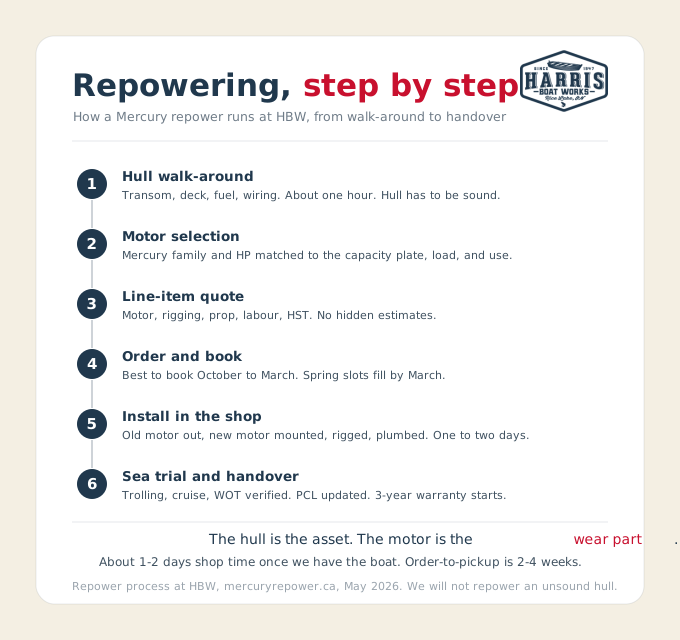
Here is the principle that the whole decision rests on: the hull is the asset, the motor is the wear part.
A 15-year-old aluminum fishing boat with a solid transom and a sound hull is not a boat that needs replacing. It is a boat that needs a new motor. Aluminum hulls do not rot. Fiberglass hulls with sound structure run 30 years and more. What gives out is the motor, and when it does, you have two real options.
Buy new. A comparable new boat-and-motor package means absorbing immediate depreciation, starting a fresh financing cycle, and spending a season learning a hull you do not know yet.
Repower. Put a new Mercury on the hull you already know. You keep the layout that works, the fit-out you have customized, and a boat that has earned your trust. It costs a fraction of new, the warranty resets to a fresh 3-year term, fuel economy improves over an older motor, and the noise drops noticeably.
Most Kawartha boaters who run the numbers land on the repower. As of 2026, a repower typically costs around half of a comparable new package, often less. For the full line-by-line cost picture in current dollars, see our Mercury repower cost guide. This guide focuses on the process.
“My old Johnson 90 finally let go on the Trent-Severn last August. Jay walked me through the new vs used math, and the new Mercury was actually the cheaper play once I ran 5 years out. Should have done it in 2022.
–Brian K.–HBW Bewdley repower customer, 2025
The boaters who regret a repower are almost always the ones who put a new motor on a hull with a soft transom. That is why the transom check comes first, and why we do one before quoting anything.
Step 1: Is Your Hull Worth Repowering?
Honest answer before anything else. Not every hull should get a new motor.
Signs your hull is worth it:
- Aluminum: solid rivets, no major stress cracks along the keel, a firm transom. Aluminum fishing boats from the 1970s and 1980s were built heavy and they last.
- Fiberglass: no delamination on the hull sides, no soft spots on the deck or floor, no flex when you push hard on the motor bracket.
- The boat is fine and the motor is the problem. That sentence, said honestly, usually describes a repower.
Signs to think twice:
- A soft transom. Push on the motor bracket and feel for give. Give means water has reached the transom core and it is rotting from the inside. A transom repair is non-negotiable before a new motor goes on, and it adds real cost and time to the project. Sometimes it is still worth it. Sometimes it is the start of a longer conversation about the hull.
- Rotten floor or deck. Structural deck rot changes the math. Now you are not repowering, you are rebuilding.
- Several systems failing at once. If the motor, the floor, the wiring, and the fuel tank all need attention together, compare the total against what a clean used boat would cost.
Step 2: Choosing the Right Mercury
This is the decision that anchors everything else.
Start with the capacity plate. Every boat carries a capacity plate that lists the maximum horsepower the hull is rated for. That number is the legal ceiling, not a suggestion for average use. HBW does not overpower a hull.
Match the motor to how you actually use the boat, not how you might use it someday. Three questions move the answer:
- How many people are regularly aboard? Two anglers and gear is a different load than a family of five and a cooler.
- What water do you run? A calm cottage lake, the open south end of Rice Lake in an afternoon wind, and the Trent-Severn main channel in October are three different answers.
- Are you trolling or running? Walleye trolling and slow panfishing want control at low speed, which points toward a Command Thrust gearcase and often a 9.9 ProKicker. Running hard and planing fast points toward more top-end horsepower.
Motor Recommendations by Hull Type
| Hull |
HP range |
HBW recommendation |
| 14-16 ft aluminum console |
40-60 HP |
Mercury 60 FourStroke, Command Thrust if consistently loaded |
| 16-18 ft aluminum fishing boat |
75-115 HP |
Mercury 90 or 115 FourStroke, 90 for lighter use, 115 for regular full loads |
| 18-20 ft aluminum or fiberglass console |
115-150 HP |
Mercury 115 or 150 FourStroke with Command Thrust |
| 18-22 ft pontoon |
90-150 HP |
Mercury 115-150 Command Thrust, pontoon thrust needs are real |
| 19-21 ft bass or tournament boat |
150-250 HP |
Mercury FourStroke for real-world use, Pro XS if you run tournaments |
| 22-24 ft tritoon or large pontoon |
150-200 HP |
Mercury 150-200 Command Thrust |
FourStroke or Pro XS?
The FourStroke is the everyday motor: quiet, fuel-efficient, and built for recreational use from sunrise to dock. It is the right choice for the large majority of Kawartha repowers. The Pro XS trades some fuel economy for a harder hole-shot and higher top end. It earns its price for tournament anglers and people who really do run their boat hard. When in doubt, the FourStroke. Our FourStroke buyer guide goes deeper on the families.
Step 3: What Else Goes on the Bill, Beyond the Motor
The motor is roughly two-thirds of a repower's total cost. The other third is what the motor needs to actually run on your boat, and it is where budgets get surprised. You do not need exact prices to plan, you need to know what drives them.
| Item |
What it covers |
What drives the cost |
| Controls |
Throttle, shift, cables, control box |
Mercury-to-Mercury is the cheap path. A brand conversion or a digital-controls upgrade costs more. |
| Steering |
Cable, hydraulic, or power-assist |
Cable steering is fine up to about 115 HP. Hydraulic is required at 150 HP and above. |
| Propeller |
Aluminum or stainless |
Aluminum suits most installs up to 115 HP. Higher-HP motors usually want stainless. |
| Gauges and SmartCraft |
Digital display and wiring |
Older boats with aged wiring cost more to bring up to a clean digital setup. |
| Battery and harness |
Battery, fuse panel, connectors |
Boat age drives this. Older electrical systems need more replaced. |
| Labour |
Shop time for the install |
A clean install is one to two days. Hull condition is what moves this number. |
| Sea-trial |
On-water test before delivery |
Always included. Never billed separately. |
For the actual dollar ranges in current Canadian pricing, the repower cost guide has the full breakdown, and the configurator at mercuryrepower.ca builds a real number for your exact motor.
The brand-conversion cost. Switching from Evinrude, Yamaha, or Honda to Mercury means the existing controls, gauges, and sometimes the wiring harness will not carry forward. The systems do not speak the same language. That conversion is real money, but it is a one-time cost. Every repower after the first one is Mercury-to-Mercury, and the rigging bill drops.
Step 4: The Hull Walk-Around and the Quote
Before we order anything, we look at the boat. Every HBW repower starts with a hull walk-around. It takes about an hour, and here is what we check:
- Transom. Moisture meter, plus a hands-on push on the motor bracket. A firm transom is what you want to hear. A soft reading means a transom conversation before the motor conversation continues.
- Floor and deck. We walk it. Soft spots mean water intrusion, sometimes cosmetic, sometimes structural.
- Wiring. Old wiring does not always play well with a new motor. We check what can stay and what needs replacing.
- Fuel system. A 15-year-old tank and lines that have run ethanol-blend fuel get flagged. Fuel problems found after the new motor is on are expensive and preventable.
- Controls and gauges. We assess what stays, what adapts, and what gets replaced, so there are no surprises at pickup.
Then we build a line-item quote. Motor, rigging, prop, labour, HST, all visible before you decide. No "call for pricing," no estimate that quietly grows by pickup. If something changes mid-job, a surprise behind the dash or a fuel line that needs replacing, we call before we proceed. You can build the starting quote yourself at mercuryrepower.ca in a few minutes. The walk-around adds the hull-specific items on top.
Step 5: Ordering and Lead Times
Once the quote is signed, we order from Mercury Canada. As a rough guide for 2026: common motor sizes that are in stock move quickly, special configurations take longer, and high-horsepower V8s can take several weeks depending on supply.
The best time to order is October through March. Off-season orders get first pick of Mercury Canada inventory, the shop has availability, and the boat is ready when the water opens. Every spring the phone rings in April with someone hoping for a May delivery. Sometimes we make it happen. Sometimes we cannot, and nobody wants to miss the start of the season because they waited. If you are reading this in spring and planning for this season, call today.
Step 6: The Install and Sea-Trial
A clean repower, meaning a solid hull, Mercury-to-Mercury controls, and a standard shaft length, takes one to two days of shop time. Here is what happens in those days:
- Old motor removed, lower unit and transom inspected
- New motor mounted to the transom
- Controls connected and routed: cables, harness, throttle, shift
- Fuel line plumbed
- Gauge and SmartCraft connections made
- Prop installed and torqued
- Cooling system and oil levels confirmed
- First-start sequence completed in the shop
- Sea-trial on Rice Lake: trolling speed, cruise, wide-open throttle, gear shifts, prop pitch verified
- Pleasure Craft Licence paperwork updated
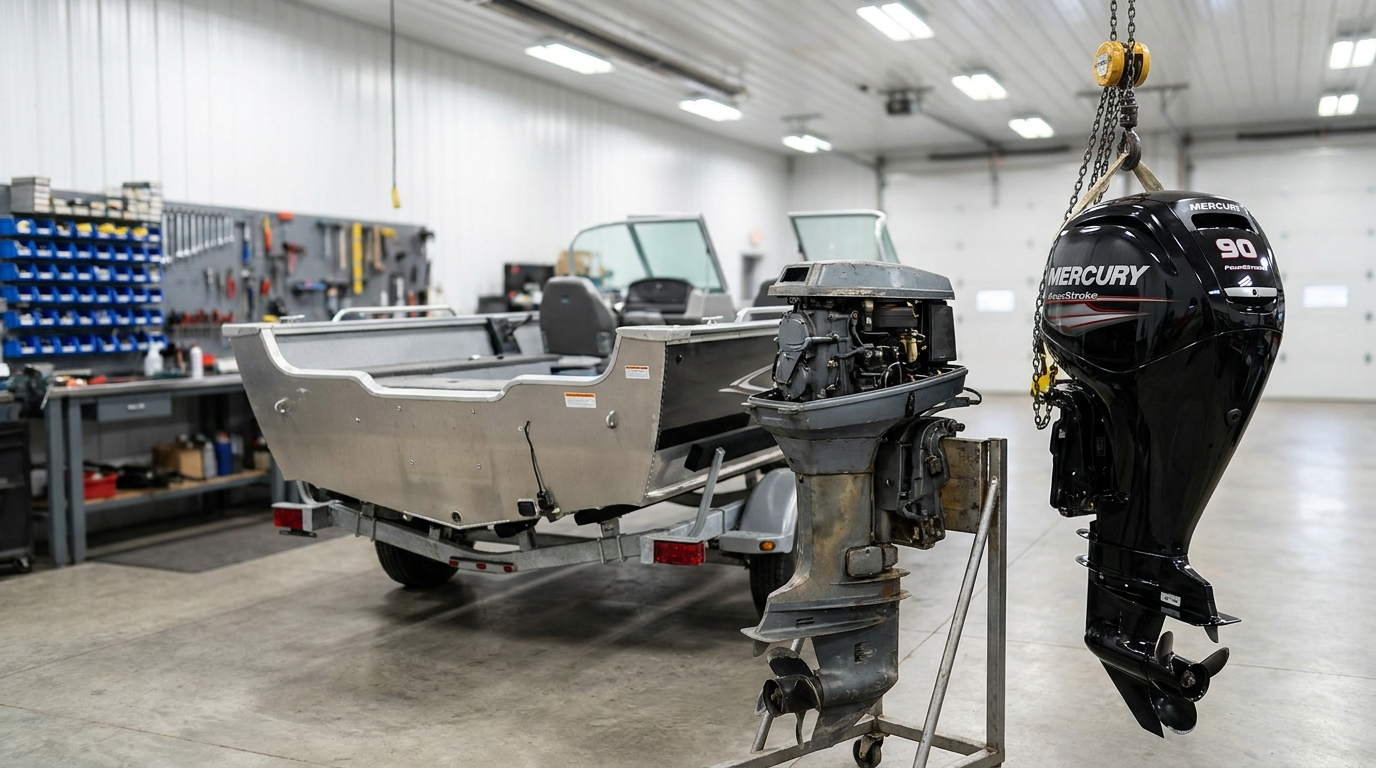
The boat does not leave until it passes the sea-trial. That is not a marketing line. It is how a marina that has been on this water since 1947 protects its name. Transport Canada requires a Pleasure Craft Licence update whenever motor horsepower or brand changes, and we handle that for every HBW customer at no extra charge.
Step 7: Pickup, Warranty, and Service
You pick up a boat with a 3-year Mercury limited warranty on the new motor. It covers manufacturing defects and is honoured by any authorized Mercury dealer across Canada. HBW also runs seasonal Mercury promotions through the year, so check the promotions page for what is current when you book.
A new Mercury FourStroke needs annual service, or service every 100 hours, whichever comes first. That covers engine oil and filter, gear lube, fuel filter, spark plug inspection, a throttle body check, and an overall inspection. Mercury's schedule puts water pump service in the 300-hour range, and many owners replace the impeller every 2 to 3 seasons. The impeller is the single most important item on the list. It is a rubber pump that circulates cooling water, and when it fails, overheating can come on fast.
A word on protecting your warranty. Mercury warranty claims require documentation of proper maintenance, so keep your service records. Running the wrong prop pitch, neglecting annual service, or using the motor outside its rated application can create warranty problems, and in some cases insurance and liability problems too. None of that is exotic. It is the ordinary care any motor needs, and it is one more reason we test the prop before you leave the dock.
HBW services Mercury and MerCruiser. Book at hbw.wiki/service. The most efficient slot is fall: combine annual service with winterization in one appointment, everything sorted before the motor sits for the cold months.
What We See at HBW
Three generations of repowering boats on these lakes teaches you the pattern. The repowers that go smoothly and stay smooth are the ones where the hull got an honest look first. The ones that turn into headaches are almost always a good motor bolted to a hull that was hiding a soft transom or tired wiring.
So we lead with the walk-around, and we tell you what we find even when the finding costs us the job. We would rather lose a motor sale than put a new Mercury on a hull that is going to give you trouble two seasons from now. A repower done right should give you ten or fifteen years of starting on the first turn. That only happens when the boat under the motor is sound.
Common Mistakes
Skipping the transom check. The most expensive repower mistake there is. A new motor on a soft transom is money spent on a countdown timer.
Buying the minimum horsepower to save money. Underpowering a hull for real-world Kawartha use, full loads and afternoon wind, is a decision people regret by August. Match the motor to how you actually boat.
Carrying over a tired prop. The prop is what turns horsepower into performance. A wrong or worn prop quietly costs you speed, fuel, and hole-shot. We test prop pitch on every sea-trial.
Waiting until spring to order. April orders compete for May water. Off-season ordering is the single easiest way to guarantee your boat is ready on opening day.
Treating electronics as a "later" job. Gauges, fish finders, and chartplotters are far cheaper and cleaner to sort at install time than to retrofit around a finished dash.
A Few Kawartha-Specific Notes
Not every repower guide is written for this water. A few things specific to where we are:
Wind. Rice Lake, the Trent-Severn connecting lakes, and the wider Kawarthas all carry open-water exposure. Rice Lake's 32 km east-west fetch builds real chop in an afternoon west wind. Adequate horsepower is not about ego or top speed. It is about running home safely in conditions that develop faster than they looked at 8 AM.
Shallow water and weeds. Most Kawartha fishing happens in 8 to 17 feet with heavy summer weed growth. Modern Mercury FourStrokes run cleaner in weedy water than older carbureted two-strokes.
The Trent-Severn. If you run the locks, the navigation season runs roughly mid-May through mid-October. Motors on the system want reliable mid-range cruise and a quiet idle for lock approaches. A properly matched FourStroke handles all of it. Our Trent-Severn boating guide covers the rest.
Walleye trolling. If you fish Rice Lake for walleye, plan a ProKicker into the repower rather than as a someday add-on. Adding it later costs more and means undoing wiring we already ran.
Financing
Mercury offers competitive repower financing for qualified buyers, and HBW processes applications right in the shop. Trade-in credit on your old motor, even a dead one, reduces the amount you finance. Off-season Mercury Canada promotions sometimes improve the terms further. For the current rate and any active promotion, check the promotions page or call us.
Frequently Asked Questions
What is a boat repower?
Replacing your existing outboard with a new Mercury while keeping the hull. The job covers motor selection, rigging (controls, cables, gauges), a new prop, installation, and a sea-trial. What it costs depends on horsepower class, motor family, and the condition of your existing rigging.
Is repowering worth it on an older boat?
It depends entirely on the hull. Aluminum hulls with solid transoms can run for decades more, and sound fiberglass is similar. The motor is the wear part. We do a proper hull walk-around before recommending anything, because a new motor only makes sense on a hull worth keeping.
Repower or buy new?
For a hull in solid structural condition, a repower almost always wins on the math. You keep a boat you know and spend a fraction of the cost of a comparable new package. The exception is a hull with a soft transom or multiple failing systems, where the numbers can favour a clean used boat instead.
How long does a Kawartha repower take?
One to two days of shop time for a clean Mercury-to-Mercury install. From signed order to pickup is typically two to four weeks, depending on motor availability. Off-season repowers move fastest.
Do I need new controls?
A Mercury-to-Mercury repower can often keep recent, good-condition controls. Older equipment, or a conversion from another brand, needs new controls and harness throughout. The walk-around tells us which case you are in.
Do I need hydraulic steering?
At 150 HP and above, yes. Hydraulic steering at that power is about safe, comfortable control, and it is standard practice on higher-HP rigs. From 40 to 115 HP, cable steering is fine.
Do I need to update my Pleasure Craft Licence?
Yes, whenever motor horsepower, brand, or model changes. The update is free, takes about fifteen minutes online, and HBW handles it for every customer as part of the job.
What happens to my old motor?
Trade-in credit. Even a dead motor carries aluminum and parts value, and that credit reduces the amount you finance.
Should I switch from Evinrude to Mercury?
With Evinrude out of production since 2020, parts and service availability shrinks every year. The brand conversion adds a one-time rigging cost, but it restores full parts access, factory warranty, and resale value. For any Evinrude owner planning to keep the hull more than a season or two, the switch makes sense. See our Evinrude to Mercury guide.
When is the best time to book?
October through March. Off-season ordering gets the best motor availability and shop time. Spring slots fill by March.
Ready to Repower?
Start at mercuryrepower.ca for live pricing on every Mercury we sell, real Canadian dollars, a few minutes to build a quote.
Or call 905-342-2153. We will start with the hull walk-around, work through the right motor for how you actually boat, and give you a line-item quote before anything is ordered.
Phone: 905-342-2153
Address: 5369 Harris Boat Works Rd, Gores Landing, ON
Configurator: mercuryrepower.ca
Service: hbw.wiki/service
Sources
- Transport Canada, Pleasure Craft Licence: tc.canada.ca/en/marine-transportation/pleasure-craft-licensing
- Mercury Marine, FourStroke and Pro XS outboard ranges: mercurymarine.com/us/en/engines/outboard
- Mercury Marine, owner's resources and maintenance schedules: mercurymarine.com/us/en/service-and-support/owners-resources
- Parks Canada, Trent-Severn Waterway operating season: parks.canada.ca/lhn-nhs/on/trentsevern
Process details and recommendations are current as of May 2026. Pricing changes through the year, so build a current quote at mercuryrepower.ca and confirm the details for your boat with HBW.
About the Author
Jay Harris helps run Harris Boat Works, a third-generation family marina in Gores Landing on Rice Lake, established in 1947. HBW is a Mercury Marine Platinum Dealer and Legend Boats dealer serving Rice Lake, the Kawarthas, and Ontario boaters who want straight answers before spending real money. Read Jay's full bio.
Related guides:
